by

I was researching case law on state court websites recently and surveying what’s out there and who’s publishing what, when I encountered something totally surprising: public domain citation formats. I thought I was pretty up-to-date on free law and access to public information, but I had never heard of this. I turned to my colleague Cicely, the Citation Geek, and asked her if she had heard of it. She was surprised, too.

It turns out that starting in 1996, state courts began creating their own citation systems, adding paragraph numbers to their opinions, and requiring citation to these opinions in their rules.  The formats are called by various names: vendor neutral, universal, media neutral, and public domain. The citations are “vendor neutral” because they do not cite to a commercial reporter. They are “media neutral” because they can be used to cite electronic material (electronic access to public information was just ramping up in the late 90’s). They are “universal” and “public domain” because you do not need to rely on commercial publishers to get the official citation.
Posted in: Legal Research
by

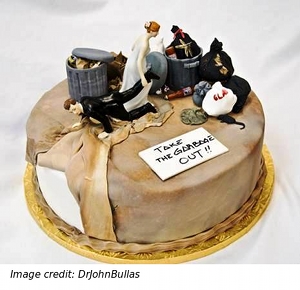
DivorceDivorce can be messy with the roller-coaster ride of emotions, the legal fight over finances, child support, and dog custody, as well as the divvying up of mementos from the marriage that did not last.

For married couples who own a small business, a divorce can be particularly challenging. Even though millions of dollars may be at stake, one spouse may be in the dark about the finances of the family business. While lengthy divorces can be expensive, does that mean that you should not fight to get what you are entitled to?

Stacey Napp, the founder of Balance Point Divorce Funding, doesn’t think so. Her company just might lend you money to fight your soon-to-be-ex in court.


by

The National Highway Traffic Safety Administration (NHTSA) promotes seat belt use across the country through its Click It or Ticket marketing campaign. This program seeks to increase seat belt use rates nationwide both through educational means and enforcement measures to reduce unrestrained passenger vehicle occupant fatalities.

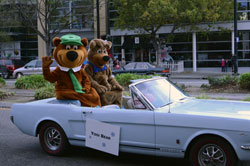
California has one of the higher rates of seat belt use in the nation. With all the out-of-town guests descending on the Golden State during the holiday season, I am not entirely surprised that some visitors may be unfamiliar with our state’s seat belt laws. For example, I recently saw Yogi Bear and his sidekick Boo-Boo cruising down the streets of San José while perched on the trunk of a moving car. Was Yogi Bear serving as a poor role model for his young fans or does some section of the California Vehicle Code excuse Yogi Bear’s oversight in this instance?


Posted in: Legal Research
by

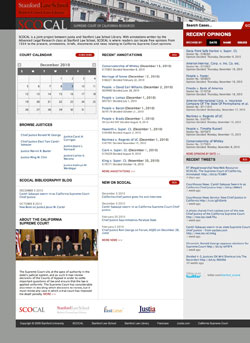
Last week marked the formal launch of a new Supreme Court of California resource center, SCOCAL (http://scocal.stanford.edu). SCOCAL is a joint project between Justia and our friends at the Robert Crown Law Library at Stanford and Fastcase. There are lots of cool features in the site and, as ever, I encourage all our readers who are interested in California law to spend some time checking it out. Below is a brief summary of what you’ll find when you visit the site.
California Supreme Court Opinions – Browse through the full text of recent opinions by date, name or issue, or search the entire collection, which includes decisions from 1934 to the present. Click on the tabs located at the top of each individual case to access related information and documents.


Posted in: Legal Research
by

British authorities arrested Wiikileaks founder and editor-in-chief Julian Assange on Tuesday based upon a Swedish warrant charging him with sexually assaulting two women there over the summer.
Assange’s arrest, along with decisions by technology companies, finance companies, and banks to distance themselves from the document-leaking web site he founded, have placed Wikileaks in a difficult position. Will the site remain under constant threat of being booted off the web?

Probably, but that just doesn’t appear likely to happen. Once Wikileaks started sharing documents with journalists around the world, it guaranteed that removing the diplomatic cables would be impossible.

Amazon evicted Wikileaks from the company’s servers, telling the group to look for hosting space elsewhere.


by

O Tannenbaum, a public domain Christmas carol, extols the venerable Christmas tree. While the lyrics may be seasonal, the melody is truly evergreen, having been remixed into other popular songs, such as Michigan, My Michigan. Now, you can hum the tune 365 days a year. Go Blue!

In the spirit of the holidays, let’s take a look at a few Christmas tree bills and laws:


Posted in: Legal News
by

As the holidays get into full swing and folks begin to make their lists of presents for young and old alike, we thought it might be a good idea to point everyone to some helpful online consumer resources. In particular, we wanted to mention two Justia web sites which allow users to look-up information on recalled items and goods.

Recall Warnings

We created the Recall Warnings site with Nolo Press to provide easy access to thousands of product recalls and and consumer alerts from the U.S. Consumer Product Safety Commission. The recalls cover a variety of products such as toys, child furniture and outdoor play items, adult clothing and accessories, products for pets, and household appliances and electrical equipment.  You can browse through various categories of goods or, if you are interested in learning more about a particular brand or item, you can also search the site.  In addition, you may create RSS feeds to help you be an up-to-date and savvy consumer all year round.


Posted in: Legal News
by

A few weeks ago, a friend at Justia celebrated his birthday. And, you know how it goes. There’s a cake involved and everyone sings that special unique song known for that occasion: “Happy Birthday.” Well, it turns out that the Happy Birthday song is copyrighted. So, for any reproduction, one must ask for permission from the copyright holder or pay a licensing fee.

Now that the holidays are coming, I started wondering about the copyright status of several of the popular songs that we hear everywhere we go during the month of December. If you like to take holiday videos and share them with your family and friends on the web, you should be aware that since January 2009, YouTube has been silencing videos with copyrighted music. So, you cannot just add any song to give your video a touch of holiday spirit.


Posted in: Legal News
by

It’s been a fun month at Justia. We launched our new Justia Legal Answers service, and we’ve been hard at work adding free law (shhh, we’ll tell you all about it soon). And of course, we’re still blogging and Facebooking [ed: not a word] away.

Here’s a sampling of the content that generated the most buzz on our Facebook page and this blog.

The highest number of page views and comments this month was for Nick’s Introduction to Wizarding Law. Everyone loves Harry Potter–and who knew there was a legal angle there? Great stuff!


Posted in: Justia News
Tagged: facebook, onward
by

Black Friday and Cyber Monday have come and gone, but there’s still time to get terrific gifts for lawyers and clients.  Here are some of our favs:

    iPad
  • The Apple iPad —  It’s sleek, small, and über cool. It holds nifty free legal apps like Fastcase to find state and federal statutes and cases and Oyez’s PocketJustice that let’s lawyers listen to Supreme Court oral arguments.  When your attorney friend is done raging at opposing counsel’s latest outrageous offer to their client, the attorney can vent his or her anger by playing Angry Birds or Star Wars Falcon Gunner. Plus, it makes them (and everyone they meet) think that they’re a swell lawyer, right?
  • Adopt a Volume of the Federal Reporter — No, we’re not crazy (at least not all the time)!  For $1,200, you can actually make a tax-deductible donation to Public.Resource.Org to support scanning a volume or two of the first series of the Federal Reporter of the United States in the name of your favorite lawyer or law firm.  The donation is to help them “adopt” a volume of federal case law  from 1880 – 1924 that is now in the public domain.