by

Trojan Horse by Marion E (sjsharktank on flickr)On Monday, Gabriel Saldana offered some social media privacy tips for stalking victims. His advice about quitting Facebook is on the mark, and not just for people victimized by stalkers. While Facebook is a popular gateway into a virtual world of friends, status updates, and likes, it may also serve as a social engineering Trojan horse for those seeking to do you harm.

Consider the following security questions that banks and other financial institutions often use to safeguard your account?
by

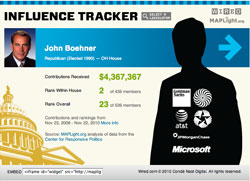
John Boehner - Contributions via Wired Influence TrackerWe’ve come a long way from a parking garage in Virginia. While some of our readers may already know of MapLight.org, I wanted to make special note of this terrific site that tracks the connection between money and politics, especially in light of recent reports that corporate contributions have surged to the new Republican leaders of the 112th Congress.

MapLight helps citizens hold their legislators accountable by creating an easy interface to drill down and research the relationship between campaign contributions made by lobbyists and corporations to specific lawmakers on the one hand, and the votes these legislators make for or against specific bills on the other. Users can follow the money trail in a variety of ways. If you have a specific bill you’re interested in, you can search for it, or also quickly access “Bills in the News.” For instance, check out the page for the Patient Protection and Affordable Care Act where you can track the total contributions made on either side of the bill, look at “$ Near Votes” which provides total contributions given to House members within 30 days of the vote, or review charts and graphs generated by this data for some interesting visuals.


by

Last month, President Barack Obama proclaimed January 2011 as National Stalking Awareness Month to raise awareness of stalking and to offer support to stalking victims and survivors. While stalking is a crime in all 50 states and the District of Columbia, many people underestimate its effects and consequences. President Obama acknowledged our heightened awareness of stalking and its prevalence since Congress passed the Violence Against Women Act in 1994; however, he noted that such criminal behavior is still often treated as being harmless.

The National Stalking Awareness Month website provides educational material for the public and resources for stalking victims. The website notes that unlike other crimes, stalking is not a single, easily identifiable crime but a series of acts—a course of conduct directed at a specific person that would cause him or her fear. Often, stalking behaviors may be understandable only to the stalker and victim, and appear harmless to others not familiar with the situation, making it difficult to recognize, investigate and prosecute.


Posted in: Legal News, Privacy
by

Getting Organized Over Organized Crime

Like death and taxes, organized crime appears to be an unavoidable part of life around the world. Today’s FBI arrest of at least 100 alleged members of La Cosa Nostra on the East Coast is just the latest chapter in a real-life saga.

Would you rather be an educated organized crime buff, or do you prefer to be stuck in stereotypes from the movies (The Godfather), TV (The Sopranos), and fiction books? After all, criminal syndicates have been part of American life for centuries.

Don’t think that organized crime only involves New York’s ‘Five Families’ — the Bonnano, Columbo, Gambino, Genovese, and Luchese criminal syndicates accused today.


by

Gadsden Flag by Vikrum LexiconA hat-tip to Mary Minow for alerting readers via her Library Law Blog post last week that Representative Mike Rogers of Michigan introduced HR 67 on January 5, 2011 to extend the PATRIOT Act yet another year to February, 2012. Given the short amount of time available to renew the Act and that the renewal period is only a year, most feel the extension is likely to happen without much notice or pushback. Congress passed the original PATRIOT Act in response to the September 11, 2001 attacks on the World Trade Center and Pentagon. Much has been written about its provisions which, among other things, allow expanded use of National Security Letters, permitting the FBI to search telephone, email and other electronic records without first securing a court order. In particular, within the library community, alarm has been raised by provisions which grant law enforcement access to library patron records.

Patriot Act Resources

  • H.R.3162 – USA PATRIOT Act, Original 2001 Bill, 107th Congress

Posted in: Laws, Legal News, Privacy
by

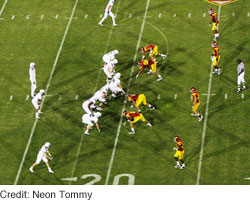
Oregon Ducks v. USC Trojans :: Credit Neon TommyNCAA sanctions played a large role in this year’s college football season, most notably in the case of sanctions against the USC Trojans. USC was sanctioned for “lack of institutional control” with the loss of 30 scholarships, a two-year ban on participating in a bowl game, four years of probation, and the forfeiture of 14 games they had won from December 2004 through the rest of the 2005 season.

The NCAA investigation determined that while Reggie Bush was playing for USC, he allegedly accepted gifts, ranging from a rent-free home for his family to a car, from two sports marketers. The NCAA does not have the power to sanction Bush as a former player, although he did return his 2005 Heisman Trophy, without ever admitting wrongdoing.


Posted in: Legal News
by

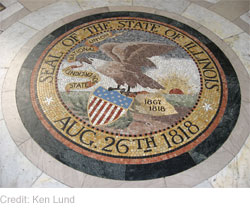
A bill to abolish the death penalty in Illinois has cleared the House and the Senate, and is now in front of Governor Pat Quinn for approval. If he signs this bill, Illinois will become the 16th state to ban capital punishment.

You can view the bill on the Illinois General Assembly Site. From the synopsis, the bill:

“Amends the Code of Criminal Procedure of 1963. Abolishes the death penalty. Provides that all unobligated and unexpended moneys remaining in the Capital Litigation Trust Fund shall be transferred into the Death Penalty Abolition Fund, a special fund in the State treasury, to be expended by the Illinois Criminal Justice Information Authority, subject to appropriation, for services for families of victims of homicide or murder and for training of law enforcement personnel. Amends the State Finance Act to create the Fund. Repeals the Capital Crimes Litigation Act. Provides for severability.”


Posted in: Laws, Legal News
by

Comedianssatirists, and Fake Steve’s everywhere, take note: under California’s new anti-Internet impersonation law, you want to make sure that you show your intent to tickle your reader’s funny bones on the Web.

That’s because under California Penal Code Section 528.5, someone who “knowingly and without consent” uses the Internet to “credibly impersonate[] another actual person” with the intent of “harming, intimidating, threatening, or defrauding another person is guilty of a misdemeanor.”

Some high-profile personalities and companies in California could put the new law through its paces in court. Here’s why.


by

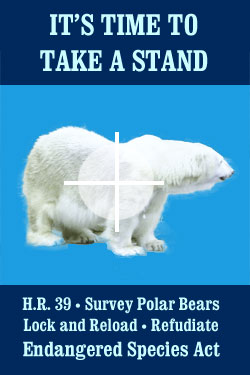
January 3rd, 2011 marked the start of the 112th United States Congress, which shifted control of the House of Representatives to the Red Republicans. In a moment that harkened back to a prior Red Revolution, Rep. Steve Scalise (R-LA) promptly introduced legislation seeking to end the reign of the Tsar.

In all seriousness, the true focus of the Republicans is H.R. 2, also known as the Repealing the Job-Killing Health Care Law Act. But, if truth be told, the real job killer is not the Patient Protection and Affordable Care Act, which President Obama signed on March 23, 2010. Just look at the Unemployment Rate Chart, which I have created with help from the Bureau of Labor Statistics.


Posted in: Laws, Legal News
by

One of the perks of working at Justia is that our office is just a few doors down from a Starbucks. Chances are on any given day you’ll find a steady stream of Justians popping over at some point to re-fuel on caffeine and load up on something to eat.  Imagine how surprised a group of us were last week then to see that the coffee chain now posts the calorie content of their drinks and food – uh oh – we’d been busted!  While I fretted over the 400+ calorie scones, Courtney and Ken noticed the high counts of some of their favorite drinks and all three of us wondered what was going on.  Is Starbucks suddenly concerned about our health or, more likely, is there some new law we didn’t know about that now makes it mandatory to list this nutritional information.

Meet California Health and Safety Code Sec. 114094 – California’s new menu labeling law! Turns out this law has been on the books since 2008, but given that establishments covered under its provisions had until December 31, 2010 to make calorie counts and other nutritional information available to customers, none of us were aware of it.