by

Show of hands – who here thinks Sunshine Week marks the horrible time of year we drag ourselves out of bed after “losing” an hour of sleep with the change to Daylight Saving Time? Okay, sorry, those of you with your hands up, put them down, you’re wrong.  Sunshine Week is actually a national initiative designed to promote a dialogue about the importance of open government and freedom of information.  Started in 2005, Sunshine week is celebrated annually in March and coincides with National FOIA Day and James Madison’s birthday.

There are a variety of events held all over the country during Sunshine Week , a round up of which can be found at the Sunlight Foundation site. That said, to participate, you don’t need to attend an event, all that’s required is that you do something to engage in a discussion about the importance of open government. Check out Sunshine Week’s Local Heroes to see examples of what other folks have done to engage in the conversation.

Want to Learn More? Check out these additional Sunshine Week resources.

Posted in: Legal News
by

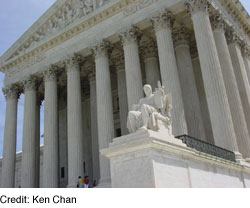
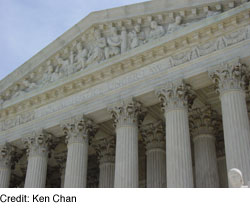
On Monday, the Supreme Court released its 6-3 decision in Skinner v. Switzer. Skinner was convicted of capital murder in Texas, and sought to compel DNA testing to prove his innocence. Texas Code of Criminal Procedure Chapter 64 bars defendants who did not request testing at trial from doing so post-conviction. The issue before the Supreme Court was whether the defendant may seek access to the testing in federal court under 42 USC 1983, or whether that remedy was only available through a writ of habeas corpus under 28 USC 2254.

The Court held that federal courts have jurisdiction to hear the defendant’s complaint in a Section 1983 civil rights action. Defendant neither was seeking “speedier” release from custody in the action, nor was he challenging a Texas court’s ruling on merits. He was only challenging their interpretation of the law. This ruling allows the federal court subject matter jurisdiction over the defendants’ claim–it does not reach the merits. Defense attorneys are pleased with this ruling because it “slays the procedural dragons” that inhibit petitioners’ efforts toward exoneration in federal court.


by

Attention spans are getting shorter.  You can only tweet 140 characters. Courts have pleading length restrictions. Judges’ case dockets are packed.

So, how can you get your case to seize the attention of the judge?

If you can use an image that makes a powerful, effective statement about your client’s stance in the case — e.g., putting a picture of your copyrighted work next to the allegedly infringing work — you could grab the judge’s (or her law clerk’s) attention.


by

I am dedicating this episode of Congressional Haiku to Representative Cliff Stearns (R-FL).

Interwebs awake

From winter dreams. Dot.gov links,

PageRank blossoms.

Washington is no stranger to political gridlock. And, we expect a certain amount of intransigence when Republicans and Democrats coalesce. But, in a shocking act of all that’s wrong in the Capital City, Congress may be stepping in to compel one government website to link to another. Of course, the surprise is that both websites are presumably run by the same organization–the U.S. Department of Veteran Affairs.


Posted in: Laws
by

This week, I want to point our readers over to a recent post by Joe Hodnicki at the Law Librarian Blog. Joe notes a letter sent recently to the Librarian of Congress, James H. Billington, requesting that Dr. Billington appoint a Director of the Congressional Research Service (CRS) to assist in the release of unclassified and non-confidential CRS Reports. Among others, the American Association of Law Libraries, Citizens for Responsibility and Ethics in Washington, Free Government Information, Public Citizen and the Sunlight Foundation signed the letter. (A full list appears in the blog post.)

The letter speaks to the accessibility of these valuable public policy (and public domain) documents, which are prepared by the Congressional Research Service for the members and staff of the U.S. Congress. While U.S. taxpayers spend nearly $100 million to fund the CRS, Congress does not disseminate the reports in any systematic way, and no comprehensive list of these reports is even publicly available from which to request reports.

I know it’s not lost on most of you that this is a movie we’ve seen before (or, rather, we see time and time again). It’s time to remove the barriers to access and paywalls we see that surround all public domain legal and government materials.


Posted in: Legal Research
by

New Jersey’s governor Chris Christie vetoed a bill on Thursday that would have legalized online gambling inside the state’s borders. Several other states, including Iowa, California, and Florida are considering similar legislation.

In New Jersey, those in favor of the bill touted it as a way to create 1,500 jobs in Atlantic City, the only part of the state where casino gambling is currently legal, and bring in $35 million in tax revenue. Christie vetoed the bill because he felt that voters should be the ones to approve such a measure. Polls show that 67% of New Jersey voters are not in favor of legalized online gambling.


Posted in: Laws
by

The Supreme Court has handed down opinions in some of the cases that we blogged about back in October. Here are the updates.

FCC v. ATT

Back in October, I wondered whether this case would add to the growing list of personal rights for corporations. The short answer is no. The Court held that corporations are not entitled to a “personal privacy” exemption from disclosure under the Freedom of Information Act. 5 U. S. C. §552(b)(7)(C).


by

Students participate in mock trial and moot court competitions all over the country. From high school to law school, the pressure and nerves ramp up as teams prepare witnesses, finalize arguments, polish their briefs, and seek to advance from local to national level competitions. This also means that lawyers will have plenty of opportunities right around the corner to donate their time.

The various advocacy competitions going on in our neighborhoods are not only great learning opportunities for all students alike, but also an option for fellow lawyers to give back to their communities and to help shape the lawyers of tomorrow. Recently, I participated in two very different advocacy competitions: I scored the Barristers 2011 Mock Trial Competition and volunteered as a presiding judge for the regional ABA NAAC Moot Court Competition here in San Francisco.


Posted in: Legal News
by

Last month, the Black Economic Council, Latino Business Chamber of Greater Los Angeles and National Asian American Coalition staged a protest at Google, demanding data on the racial make-up of its employees.

The specific dataset sought by the protesters was the EEO-1 Report, which is filed by all employers with 100 or more employees or certain federal government contractors with 50 or more employees. This report collects the race/ethnic, gender and job categories of employees, and is confidential. The EEOC estimates that this reporting requirement impacts about 45,000 private employers and imposes “599,000 burden hours,” costing respondents $11.4 million and the federal government another $2.1 million–that’s bureaucratese for time and money sink.


Tagged: EEOC, Google
by

This week, I thought it might be helpful to pull together a few online resources for anyone interested in tracking the labor dispute with Wisconsin’s Governor Walker.  I’ve also included some general U.S. labor law resources, and for music lovers, don’t miss our bonus track!

Wisconsin