by

The Administrative Office of the US Courts issued a press release last week announcing that a “New Pilot Project Will Enhance Public Access to Federal Court Opinions.” According to the statement, select federal appellate and district courts will make their published opinions available on FDSys, as “FDSys can provide the public with a robust search engine that can search common threads across opinions and courts.” FDSys is run by the Government Printing Office (GPO), which issued a similar statement.

Let me start by saying I think this is a good thing. PACER has a lot of limitations, and moving opinions into a better search engine that is free to use and search is quite helpful. I like the idea of putting the bulk of government legal material (cases, codes, memos, etc.) into one database. It helps that the database will have the imprimatur of government on it, which will quiet the concerns about authentication that always pop up in these discussions.


Tagged: Case Law, fdsys, gpo, pacer
by

Last Sunday, our nation celebrated Mother’s Day, a national holiday that recognizes the love, guidance and service that all mothers have devoted to our families and communities. However, May is about more than just mothers, as far as Washington, D.C. is concerned.
Free Comic Book Day

H. Res. 250 called on the House of Representatives to congratulate and commend Free Comic Book Day. Seriously, if you tell mom that you are reading comic books to develop literacy and a life-long love of reading, as the bill suggests, mom will not be fooled. Calling comics a wonderful educational tool that teaches narration, dialogue, and visual design is indeed a form of creative writing.


Posted in: Laws
by

Last month, I mentioned that Justia friend Mary Minow had testified before the California State Senate on Senate Bill (“SB”) 445, which proposes enhanced privacy protections for public library patrons. In yet more news concerning California reader privacy, the State Senate on Monday approved SB 602, the California Reader Privacy Act. This bill will protect consumers against unwarranted searches of records related to book purchases. While you can probably already guess that the bill covers works in both paper and digital format, of note is how “book” is defined in the bill. As Sonya Ziaja notes in her post linked below, “Under this [new] definition, news articles, blogs, magazines, and potentially some websites could all be considered “books.” This would mean that “book providers” could include LexisNexis, Google Reader, Amazon and your local bookstore.”

SB 602 now heads to the California Assembly for consideration.


Posted in: Laws, Legal News, Privacy
by

From the Sunshine State comes news that the Florida Senate has abandoned a contentious proposal to split the Supreme Court of Florida into two divisions: civil and criminal.  Under the proposal, Governor Rick Scott (a Republican) would have been able to appoint three new Justices to a newly created civil division of the Supreme Court while three sitting Justices appointed by Democratic governors would have moved over to the second division to handle criminal matters. Claims have been made that the proposal was simply a partisan attempt by Florida Republicans to pack the court with like-minded appointees. In other words, let’s just file this one under one person’s “judicial activist” is another’s “reasoned jurist.”

In reading up on the proposed split, I learned that it is part of a larger package of proposed changes coming out of the Legislature to overhaul the Florida Judiciary which will go before voters next year.  Among other items, the bill permits the Legislature to repeal judicial procedural rules of the Florida Supreme Court.  The bill also provides the Judiciary with full financing and, in light of a current $78 million dollar budget shortfall, would certainly offer some needed financial relief. Many Democrats, lawyers and judges though find it hard not to see this as simply a cynical move by Republicans of offering financial security in exchange for subverting the independence of the judiciary.

Read More


Posted in: Legal News
by

It’s that time, dear Justia readers, when we review some monthly lists. Here’s the scoop on April’s highest scoring lawyers on Justia Answers, along with a look at which Onward blog and Facebook posts readers viewed the most.


Justia’s Top 10 Legal Answerers for April 2011


    by

    CALI (Computer Assisted Legal Instruction) introduced the Free Law Reporter this week.  The FLR is a database housing published (official) legal opinions that provides a simple search interface for research.  According to CALI, “The goal of FLR is to develop a freely available, unencumbered law reporter that is capable of serving as a resource for education, research, and practice.”

    The FLR is populated with opinions from the RECOP service. There’s been a little bit of controversy over whether the opinions are being used or adopted. The archive itself is not designed for caselaw research, it’s just a repository. The goal is to make the data freely accessible in bulk access. RECOP is not a research tool, in other words. It’s where sites that run research tools get the opinions.


    Posted in: Legal Research
    by

    Unless your head has been stuck in the sand over the last week, you’ve probably spent some time wondering about how 77 million Sony PlayStation Network gamers had their online data hacked, and their credit card information possibly stolen.

    What if a hacker got a hold of your law firm data. You know: client names, addresses, and social security numbers, their bank information, your bank account, your court calendar, and — Holy $&@*#%! — your time and billing information.

    Yeah, we know: you’d scream like a 2-year-old. But then what?


    by

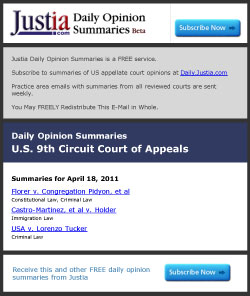
    Courtney and I wanted to update you on our latest free law offering, Justia Daily Opinion Summaries. When we announced the launch last week, we noted that our jurisdictional coverage included all Federal Circuit Courts of Appeal and select state supreme courts. The team has been working hard to expand to even more jurisdictions and we’re pleased to say that we now offer summaries for over half the 50 U.S. states.  To see a complete list of our current offerings by jurisdiction and by practice area, go to our subscription page at https://daily.justia.com.  For the few remaining states that aren’t available yet, stay tuned. We’ll be adding more in the upcoming weeks.


    by

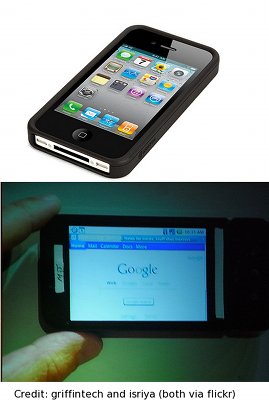
    There’s been a huge hullabaloo this week about a discovery by two engineers that Apple iPhones and 3G iPads log  users’ locations with geo-coordinates and time stamps. A day later, it was revealed that Google’s Android operating system can store two files tracking users’ travels: one based on WiFi, and the other based on cell tower triangulation.

    Oh, and one more thing. There is no federal law concerning GPS tracking, and state laws on location tracking vary.

    But doesn’t turning off any location-based settings on your phone take care of the problem? Maybe.


    by

    Who is an American? For a “corporate person,” does the answer depend on where the corporation is headquartered? Or, should we look at the composition of its workforce? Last week, I looked at some tax data found in various securities filings to calculate the tax rate paid by various corporations. Today, I wanted to see how “American” some American companies really were by digging through employment data from the SEC EDGAR System.

    EDGAR features a repository of financial data that companies have filed with the U.S. Securities and Exchange Commission. From registration statements to annual reports, EDGAR offers a detailed glimpse at the state of various domestic and foreign businesses.


    Posted in: Laws, Legal Research