


 It’s the fifth anniversary of Open Access Week and I thought I’d pull together some resources to mark the occasion for folks who might be interested in learning more about its impact on legal scholarship and free law. (NB: Hat tips to Sara Glassmeyer, Rob Richards and our peeps at Legal Research Plus!)
Open Access = Public Access = Global Access
Posted in:
Legal News, Legal Research
Tagged:
Open Access Week
TimeZone Database Editors Sued
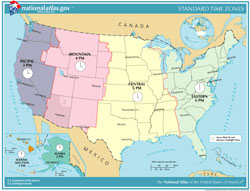 An interesting copyright suit has come across the wires: Astrolable, Inc. v. Arthur David Olson and Paul Eggert. The complaint alleges that Defendants infringed on the Plaintiff’s copyright assignment to historical time zone information with their Timezone (tz or zoneinfo) database. The Timezone database, also called the Olson Database, is a library of historical timezone information. It is intended primarily for use with computer systems, notably UNIX (from which Mac OS X is derived). That means that time zone information for computers running UNIX and Mac comes from this library, which is included in the operating system.
The tz database was originally compiled by Arthur David Olson at the NIH, and has been edited and maintained by Paul Eggert at UCLA. Olson and Eggert are the named defendants in this complaint. The database was housed on NIH servers until the complaint at issue was filed. ICANN has since taken over the database. This suit is important because UNIX systems rely on updates to the tzdatabase to run time zone information. The complaint was filed by Astrolabe, Inc., a company that sells astrology software. Astrolabe asserts that it is the copyright assignee for the ACS Atlas. It appears that the heart of the complaint is that defendants used ACS’ historical time zone data to populate the tz database.
Posted in:
Intellectual Property
Adobe Flash + Clickjacking: Who Could Be Watching You (or Not)?
 You hope that your computer is secure. Your clients depend on it, and your law firm’s insurance carrier prefers it.
An unsettling discovery by Stanford University computer science student Feross Aboukhadijeh, however, could test that theory. He says that that a malicious website using Adobe Flash, when combined with ‘Clickjacking,’ could actually turn your webcam and microphone on without you knowing it.
Creepy, eh?
Posted in:
Privacy, Technology
Justia’s Top 10 Lists for September 2011
 Here is a rundown of September’s highest scoring lawyers on Justia Legal Answers, along with a look at which Onward blog and Facebook posts readers viewed the most.
Justia Legal Answers’ Top 10 Legal Answerers for September 2011
- Jon Matthew Martinez, 850 points, 17 answers
- David Philip Shapiro, Esq., 500 points, 10 answers
- J. Richard Kulerski, Esq., 380 points, 8 answers
- Brian F. LaBovick Esq., 340 points, 8 answers
- Herbert G. Farber Esq., 326 points, 10 answers
- Andrew John Hawes, 280 points, 6 answers
- Anthony J. Pietrafesa, 280 points, 6 answers
- Mark A. Siesel, 250 points, 5 answers
- Robert Neal Katz, 250 points, 5 answers
- Mark Steven Humphreys, 200 points, 4 answers
Posted in:
Justia News
Remembering Steve Jobs

My first hands-on experience with a personal computer was when my parents brought home an Apple II Plus. That computer and its sibling, the Apple IIe, introduced our family to the unbounded world of word processing, spreadsheets and, of course, games. These computers also launched my lifelong appreciation of and affection for Apple products. From PowerBook to MacBook Pro, and iPod to iPhone and iPad, a pantheon of insanely great Apple products has delighted me over the years.
Posted in:
Technology
Tagged:
Apple, Steve Jobs
USPTO Denies ‘Casey Anthony’ Trademark Application
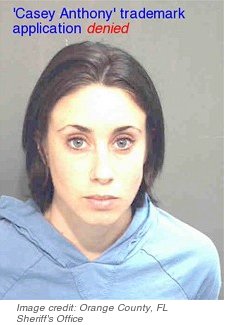 The U.S. Patent and Trademark Office rejected California company Grant Media’s recent trademark application for the phrase ‘Casey Anthony.’
Yes, that Casey Anthony: the Florida mother whom a jury acquitted of murdering her young daughter Caylee Anthony. The trial received an enormous amount of media attention on the Web, television, and in print media.
Exactly why did they USPTO reject Grant Media’s application?
Justia read the papers on file with the agency to find out, and we wanted you to see for yourself.
California Legislature Seeks to Boost Minority UC Admissions Through Cheating
 Earlier this month, the California Legislature passed SB 185. If signed by Governor Brown, the bill would add a section to California Education Code Section 66205 allowing the University of California (UC) and the California State University (CSU) to consider certain factors in admissions, “so long as no preference is given.”
UC Comprehensive Review
Currently, the UC considers 14 academic and personal factors in its admissions process. Known as the comprehensive review, this process ranks students based on the following factors:
- GPA in A-G courses.
- ACT or SAT scores.
- Electives.
- Honors and AP courses.
- Class rank.
- Senior-year program.
- “Quality of their academic performance relative to the educational opportunities available in their high school.”
- Outstanding academic performance.
- Outstanding work in special projects.
- “Recent, marked improvement in academic performance.”
- Special talents, skills, or leadership experience.
- Completion of special projects.
- “Academic accomplishments in light of a student’s life experiences and special circumstances.”
- Location of a student’s secondary school and residence.
SB 185 Factors
Under SB 185, when “attempting to obtain educational benefit through the recruitment of a multifactored, diverse student body,” the UC may consider these additional factors:
- race,
- gender,
- ethnicity,
- national origin,
- geographic origin, and
- household income.
Posted in:
Legal News
The Netflix Law: Privacy Law Stalls Facebook Integration
 Last week, Netflix announced some big changes in their structure and offerings. First, they will split into two companies: one for streaming and one for physical DVD rental. Second, Netflix subscribers will be able to share and discuss their rentals through Facebook. The Netflix blog reports: “The Netflix/Facebook integration empowers you as a Netflix member to share what you watch from Netflix with your friends on Facebook and to discover what your friends are watching both on Facebook and within the Netflix user interface. This makes it easier and more fun to find new television series and movies to watch.” Michael Drobac, Director of Government Relations at Netflix, has a caveat, however. This access will be limited to users outside of the US due to a “1980s law that creates some confusion over our ability to allow U.S. members to share what they watch.” Since Netflix didn’t cite the code or link to which “1980’s law” they are referring to, I thought it might be useful to post about it. Mr. Drobac is talking about 18 USC § 2710, “Wrongful Disclosure of Video Tape Rental or Sale Records.” This law authorizes civil penalties for release of consumer rentals or sales without informed consent of the renter or a court order.
President Obama Attends LinkedIn Town Hall in Mountain View, CA
This morning, President Barack Obama participated in a LinkedIn Town Hall Meeting at the Computer History Museum in Mountain View, California.
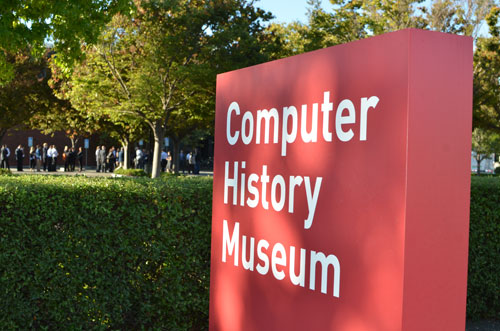
Since the museum is across the street from us, we were able to participate in some of the fanfare that a Presidential visit brings. But, the parking situation was a bit difficult to say the least.

Posted in:
Justia News
Cornell LII & Weblaws.org Visit Justia
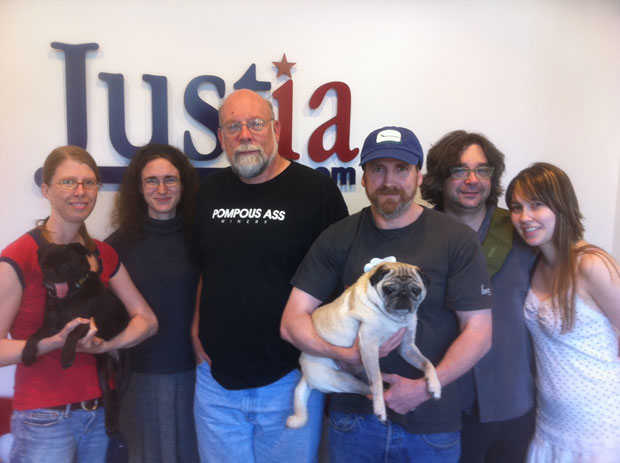
We were lucky enough this week to have two great groups of folks visit us at Justia — Tom Bruce and Sara Frug of Cornell’s Legal Information Institute, and Robb Shecter and Lisa Hackenberger from Weblaws.org. Tom and Sara were here for a few days to talk about current and (cool) future projects, topped off by a visit to Fry’s on their last day. (And Courtney and I were also lucky enough grab a few minutes to get them up to speed on our current universal citation project.) Robb and Lisa stopped by Tuesday afternoon to chat with everyone about all the great stuff Robb is up to with Weblaws.org, as well as future opportunities for collaboration. Below is a photo of the some of the gang (we leave it to Tom to explain his t-shirt :), plus our Justia ambassadors, Sheba and Rio. It was great to see all of them and hope they come back soon!
Posted in:
Justia News


