


 Carl Malamud of public.resource.org has a guest post on Boing Boing: Liberating America’s Secret, for-pay Laws. In it, he discusses the problem of laws that incorporate copyrighted technical standards by reference. Because the standards bodies that issue them are in the private sector, anyone who wants to view the standards (to comply with the law) must pay for a copy. Those copies can be very expensive; public.resource.org spent over $7,000 for copies of the corpus.
The Law: Still Not Free
Posted in:
Legal Research
Facebook TOS Claims ‘Book’ Trademark & IP Rights
 Watch out, Facebook users. Mark Zuckerberg’s social network giant recently modified the company’s Statement of Rights and Responsibilities (i.e., Terms of Service [‘TOS’]) to now allege that Facebook claims trademark rights to the word ‘Book.’ (Read it below)
Oh, and in case you forgot, Facebook also claims intellectual property rights to the words ‘Face,’ Poke, and ‘Wall’
Take a look for yourself:
An iPhone user walks into an Apple store…
 An 83-year-old iPhone user sued Apple this week, claiming that she injured herself during prime winter holiday shopping season last December by walking “directly into the clear glass doors” at the company’s Manhasset, Long Island Apple retail store in New York.
Ouch!
Who was at fault here? Plaintiff Evelyn Paswell maintains that her “injuries were due solely to the negligence of” Apple.
Posted in:
Apple, Personal Injury
This Week in Opinions
 Our Daily Caselaw Summary writers have served up some interesting cases this week:
In Colorado, the Supreme Court issued Air Wisconsin Airlines v. Hoeper, which found an airline was not immune from a defamation claim by an employee under the Aviation Transportation Safety Act. In that case, the employee was authorized to carry a firearem on the planes he flew, but was reported by a trainer to be “disgruntled” and that he posed a threat with a gun. The Colorado Supreme Court upheld the defamation victory, adding that the airline was not immune from suit or defamation under the ATSA and that the record supported the jury’s finding of clear and convincing evidence of actual malice.
Posted in:
Justia News, Legal News
Tagged:
Daily Opinion Summaries
Yahoo Mail Sender’s Class-Action Lawsuit: Revealing My Name in Email Violates TOS
 Yahoo! Mail user Albert Rudgayzer sued the Silicon Valley web portal yesterday, charging that Yahoo’s revelation of users first and last names when they send email violates the portal’s own Terms of Service (‘TOS’), constituting a breach of contract. He seeks relief under federal and California state law.
Rudgayzer, a New York lawyer, alleges that he began using Yahoo email around October 2011. He filed the lawsuit in a pro se capacity in the U.S. District Court for the Northern District of California (read the lawsuit below).
This Week in Opinions: Vaccine Safety, School Violence, Prison Hunger Strikes and The Jones Act
 The DC Circuit released an opinion about vaccine safety this week. In Coal. for Mercury-Free Drugs v. Sebelius, the Court found that plaintiffs did not have standing to sue the FDA for failing to prohibit the use of vaccines containing the mercury-based preservative thimerosal on young children and pregnant women. The court concluded that plaintiffs were not required to receive thimerosal-preserved vaccines, they could readily obtain thimerosal-free vaccines, they did not have standing to challenge the FDA’s decision to allow other people to receive the vaccines, and plaintiffs could advocate that the Legislative and Executive Branches ban the vaccines. As a result, plaintiffs were suffering no cognizable injury as a result of the FDA’s decision to allow the vaccine, their lawsuit was not a proper subject for the Judiciary.
Posted in:
Legal News
Samsung Sued Over Emoticon Patent, But Not By Apple
 Samsung was hit with a patent infringement lawsuit yesterday over an emoticon patent (see below). Plaintiff Varia Holdings LLC charges that Samsung mobile phones violate its 2007 U.S. Patent (No. 7,167,731) for an “Emoticon Input Method and Apparatus.”
Varia Holdings took a jab at the electronics giant, charging that “Samsung is a prolific patent filer that actively protects its intellectual property,” but allegedly infringes the rights of others.
Of course, there are a few twists to this case.
Google Scholar “Cited By” Update
From our friends over at Google Scholar comes word last week of changes to the “Cited by” function within their legal opinions database. For those of you not familiar with this feature, “Cited by” appears as a link under items returned in a result set. For example, the first opinion returned after a search for “347 U.S. 483” indicates it is “Cited by” 32,903 sources.
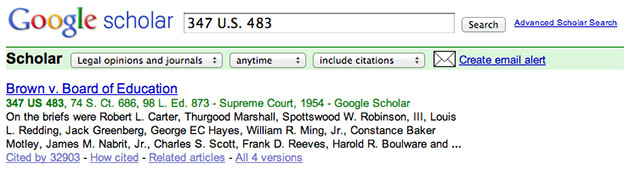
Clicking on the link brings up a separate page which, before last week’s changes, sorted citing documents by their prominence but which are now ranked by the the extent of discussion of the cited case. This means that cases that support, overturn, or clarify an opinion are ranked above those that just mention it.
Posted in:
Legal Research
Tagged:
Google Scholar
Judge Orders Righthaven to Transfer All Copyright Registrations
 It’s like a scene from the Wizard of Oz: Righthaven is almost dead as a corporate entity.
Yesterday U.S. District Judge Philip Pro ordered “the transfer of all of Righthaven’s intellectual property and intangible property” — including 278 registered works filed with the U.S. Copyright Office — to court-appointed receiver Lara Pearson tasked with breaking up Righthaven’s assets (read it below).
The order stemmed from an earlier judgment against Righthaven’s for $34,000+ in attorneys fees owed to Wayne Hoehn, a Vietnam vet who successfully got Righthaven’s copyright lawsuit against him dismissed.
Until last year, the Righthaven litigation machine shook down consumers for unfounded copyright violations to intellectual property. But Righthaven defendants had an epiphany moment.
Class Action Charges Apple iOS and Android Apps ‘Harvested’ Users’ Address Book Data
 A new federal class action lawsuit (see below) charges that a host of well-known social media, app, and mobile device companies stole “literally billions of contacts” from users’ personal address books by illegally ‘harvesting’ personal data on the sly, without their knowledge or consent.
The 152-page complaint seeks monetary damages under both federal and Texas state law that could be enormous, injunctive relief, equitable relief “to mandate fixes to these mobile devices and apps” to stop alleged privacy violations, as well as attorneys fees and expenses.
Posted in:
Apple, Class-Action, Consumer Protection Law, Cyber Security, Facebook, Litigation, Privacy, social-networking, Twitter


