


Last week, the U.S. Court of Appeals for the Seventh Circuit ruled in Teesdale v. City of Chicago that a city’s legal argument in a civil proceeding does not constitute its official policy.
 One of the threshold questions before a person or entity may sue another in federal court is one of judicial standing. When the person or entity is suing for prospective relief—that is, a court order preventing a harm that has not yet occurred, the threshold is particularly high. Under the Supreme Court case City of Los Angeles v. Lyons, a plaintiff seeking prospective relief must show that he or she is in immediate danger of sustaining some direct injury as the result of the challenged conduct, and the injury or threat of injury must be “real and immediate,” not “conjectural” or “hypothetical.” In Teesdale, the court found that Teesdale did not meet the standing requirement and thus could not go forward with his case against the City of Chicago.
 On Wednesday, New York City
 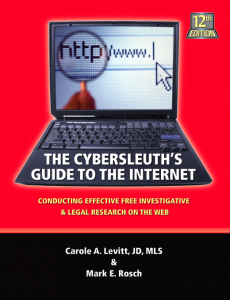 ABA authors and Cybersleuth seminar speakers Carole Levitt and Mark Rosch have revised and updated their book, The Cybersleuth’s Guide to the Internet, now in its twelfth edition.
 H-W Technology LC is suing Apple and 31 other companies for
 On July 27th, 2012, the Sixth Circuit Court of Appeals
  On July 19th, Rick Quereshi filed a
  In one week, the opening ceremony at the
 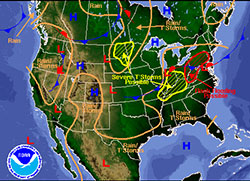 Take
Take  Last week, Sprint filed several requests for the issuance of subpoenas in the U.S. District Court for the Northern District of California. The purpose of the subpoenas, according to the declarations accompanying them, is to reveal the identity of one who identifies him/herself as a ‘mole’ or insider in the company who may be violating Sprint’s copyright. The mystery mole has a Gmail account, as well as accounts on


