Dong v. Holder, US 1st Cir. (10/3/12)
Government & Administrative Law, Immigration Law
 This case required the First Circuit Court of Appeals to decide, for the first time, whether section 1101(a)(42)(B), a statute enacted to pave the way for asylum for victims of China’s coercive population control policies, extends automatically to a spouse of a person forced to undergo an abortion. Petitioner, a Chinese national, petitioned for asylum, seeking to remain in the United States because of, among other things, his wife’s forced abortion. Petitioner argued he was entitled to per se refugee status under 8 U.S.C. 1101(a)(42)(B) “as a person who has been forced to abort a pregnancy.” The immigration judge rejected this argument, and the board of immigration appeals affirmed. The First Circuit Court denied Petitioner’s petition for judicial review after joining several of its sister circuits in holding that, given the language of the relevant statute and the Attorney General’s reasonable interpretation of it, the agency did not err in refusing to grant Petitioner’s per se refugee status on the basis that the Chinese government had compelled his wife to undergo a forced abortion.
Read More:
First Circuit: No Automatic Asylum for Chinese Men in Abortion Cases, Wall Street Journal
U.S. v. Tasis , US 6th Cir. (10/4/12)
Government Contracts, Health Law, Public Benefits, White Collar Crime
Tasis and his brother ran a sham medical clinic, recruited homeless Medicare recipients who had tested positive for HIV, hepatitis or asthma, paid the “patients” small sums in exchange for their insurance identification, then billed Medicare for infusion therapies that were never provided. During four months in 2006, the Center billed Medicare $2,855,785 and received $827,000 in return. The scheme lasted 15 months, during which Tasis and his collaborators submitted $9,122,159.35 in Medicare claims. An auditor notified the FBI. After an investigation, prosecutors indicted Tasis on fraud and conspiracy claims. Over Tasis’s objection, co-conspirator Martinez testified that she and Tasis had orchestrated a a similar scam in Florida. The court instructed the jury to consider Martinez’s testimony about the Florida conspiracy only as it related to Tasis’s “intent, plan and knowledge.” The jury found Tasis guilty, and the trial judge sentenced him to 78 months in prison and required him to pay $6,079,445.93 in restitution. The Sixth Circuit affirmed, rejecting various challenges to evidentiary rulings.


 For several months, Facebook has reportedly been developing and testing a “Want” button, to supplement its ubiquitous “Like” button. Just last week, Facebook announced that several companies will be testing the new “Want” button and showed what the button would look like.
 Apple, Inc. was hit with a patent infringement lawsuit Thursday (read it below) alleging that the company’s iPad 3 tablets and Macbook Pro computers violate four light emitting diode (LED) patents. The case was filed in in federal court in Delaware by claimed patent holder LED Tech Development LLC, a Delaware limited liability company based in Tyler, Texas, the city that is a patent litigator’s
  Dept of Texas, Veterans of Foreign Wars v. Texas Lottery Commission
 Apple was sued for copyright infringement on Wednesday by Swiss fashion and beauty photographer
  The
The  Here is a summary of legal developments in five federal and state court cases last week that involved technology companies, or alleged activities by their users.
 In a few days, several of us here at Justia will be traveling to “gorges” Ithaca, New York, to attend the
  A former Chairman of the the Advisory Board of a professional mutual fund pleaded guilty today in federal court to a series of charges in a $13 million conspiracy to defraud in investors by falsely claiming that Praetorian Global Fund Ltd. privately owned pre-IPO Facebook and Groupon stock before each of the social media start-ups went public. In reality, the British Virgin Islands-based fund did not.
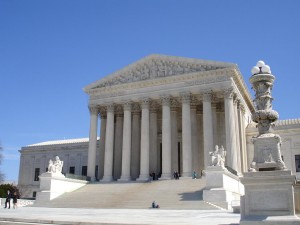 The U.S. Supreme Court started its term today, hearing oral arguments for Kiobel v. Royal Dutch Petroleum. The case involves the interpretation of a federal statute enacted by the first Congress as part of the Judiciary Act of 1879—the Alien Tort Statute.


