by

According to a new infringement lawsuit filed Tuesday in federal court (read it below), the Google Wallet app violates a Canadian resident’s U.S. patent.

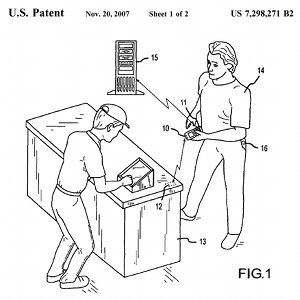
Plaintiff Peter Sprogis holds U.S. Patent No. 7,298,271 for a “Method and apparatus for providing awards using transponders.” The ‘271 patent abstract describes a customer loyalty program using ‘electronic data storage elements’ (EDSE) like RFID tages can be used to encourage customer loyalty by offering coupons or loyalty points for visiting a business.

Sprogis accuses Google of infringing at least nine claims listed in his patent.

The plaintiff’s claims appear to paint a wide swath over Google’s app. Google Wallet enables Android phone users to securely store credit and debit card information on their mobile devices to shop locally as well as online.


Tagged: Google, mobile, patent
by

Facebook, online advertising agency adSage, and a web-based wholesaler of Chinese goods are named as defendants in a new class-action trademark lawsuit  accusing them of enabling the placement of, or placing ads for, counterfeit NFL apparel on the social network. (read it below)

Inkies Sports, Inc. d/b/a Krystal’s NFL Shoppe, a New Mexico-based retail store that only sells “officially licensed NFL merchandise” filed suit. Krystal’s charges that a litany of ads on its Facebook page offer competing, counterfeit merchandise at prices that can be 80% – 90% below the MSRP of an authentic, officially licensed NFL jersey.

But should Facebook and advertising agencies be held accountable for alleged wrongdoings of third party advertisers accused of hawking cheaper counterfeit goods? Prior case law suggests not.

Two years ago a federal appeals court held that eBay was not liable to Tiffany, Inc. for trademark infringement or dilution by offering Tiffany goods for sale that third parties listed for sale. It sent the case back to a lower court to further examine Tiffany’s false advertising claim, and determine whether extrinsic evidence showed that advertisements misled or confused consumers about Tiffany products offered for sale. The U.S. District Court ultimately ruled that eBay was not liable for false advertising, since it failed to obtain survey data showing that a substantial portion of consumers were misled.


by

Apple was hit with a patent infringement lawsuit (read it below) over Siri, the Cupertino, California company’s computer voice search-and-speak technology inside newer iPhones, iPads and iPod Touch devices. The twist in this case, however, is that patent holder Rensselaer Polytechnic Institute isn’t the one suing.

Instead, the plaintiff is Dynamic Advances, LLC, a Tyler, Texas-based company created last year by patent monetizer Erich Spangenberg. The LLC’s members and officers include the Spangenberg Family Foundation and Techdev Holdings.

Spangenberg is known for his sue first, ask questions later approach to patent litigation.

A lawsuit filed Friday in a New York federal court confirms that Dynamic Advances, LLC is a non-practicing entity (NPE) allegedly holding an exclusive license to sue, enforce, and monetize Rennselaer’s patent portfolio:

Dynamic Advances facilitates Rennselaer’s goal of commercializing its patented inventions to the benefit of the general public, and to further Rennselaer’s mission to apply science to the common purposes of life.

Pleadings in the case docket do not currently include a copy of any alleged exclusive patent license agreement between Rennselaer and Dynamic Advances.

The patent at issue is U.S. Patent No. 7,177,798 for a “Natural language interface using constrained intermediate dictionary of results.” The USPTO awarded the patent in 2007.


by

A consumer Apple iPhone class-action antitrust lawsuit (read it below) accuses the Cupertino, California, company of conspiring to monopolize early iPhone purchasers’ voice and data plans by locking them into exclusivity contracts with AT&T Mobility, in violation of federal antitrust law.

The proposed class of plaintiffs includes consumers who bought iPhones between October 19, 2008, and February 3, 2011. This corresponds to the period of time when Apple sold three versions of the company’s iPhone: the original, 3G, and 3Gs models.

The plaintiffs are asking for a permanent injunction prohibiting Apple from selling locked iPhones that can be be used only with AT&T Mobility SIM cards, unless consumers get adequate disclosure before their purchase, and an order requiring Apple to give an unlock code to any iPhone customer who wants one.

Plaintiffs Zack Ward and Thomas Buchar also seek an unspecified amount of treble damages against Apple under federal law, in addition to attorneys fees. Apple is the sole defendant in the lawsuit; neither AT&T Mobility, nor any related business units at the telecom was named a party.

The suit alleges that Ward and Buchard each wanted to switch their iPhone plans from AT&T to a different, competing telecom provider. Buchar also contends that by locking iPhone customers’ SIM cards when traveling outside the U.S., he was unable “to switch his iPhone service to a local voice and data service provider while roaming.”

The lawsuit chastises AT&T for unlocking SIM cards on other phones it sells, like Blackberry and Samsung devices, and claims that “[t]here is but one exception: the iPhone,” citing a five-year exclusivity agreement between Apple and AT&T Mobility.

This case has a quite a few hurdles to overcome, however.


Posted in: Legal News
by

Burns v. Astrue, Utah Supreme Court (10/12/12)
Family Law, Public Benefits, Trusts & Estates
Here the Supreme Court answered a question of Utah law certified to it by the U.S. district court. The question was, “Is a signed agreement to donate preserved sperm to the donor’s wife in the event of his death sufficient to constitute ‘consent in a record’ to being the ‘parent’ of a child conceived by artificial means after the donor’s death under Utah intestacy law?” In this case, after she gave birth, the wife of the donor applied for social security benefits based on the donor’s earnings. The Social Security Administration denied the benefits, finding that the wife had not shown the child was the donor’s “child” as defined by the Social Security Act. The wife subsequently filed a petition for adjudication of paternity, and the district court adjudicated the donor to be the father of the child. On appeal, the U.S. district court certified the state law question to the Supreme Court. The Court held that an agreement leaving preserved frozen semen to the deceased donor’s wife does not, without more, confer on the donor the status of a parent for purposes of social security benefits.

Annechino v. Worthy, Washington Supreme Court (10/18/12)
Banking, Consumer Law, Insurance Law
The issue before the Supreme Court in this case was whether particular officers and employees of a bank owed a quasi-fiduciary duty to particular bank depositors. Michael and Theresa Annechino deposited a large amount of money at a bank specifically to ensure that their savings would be protected by the Federal Deposit Insurance Corporation (FDIC). The Annechinos relied on bank employees’ recommendations of how to structure their accounts to meet FDIC coverage rules. Unfortunately, the bank went into receivership, and the FDIC found that nearly $500,000 of the Annechinos’ deposits were not insured. The Annechinos alleged that individual officers and employees of the bank owed them a duty, the breach of which resulted in their loss. The trial court granted summary judgment in favor of the individual defendants, and the Court of Appeals affirmed. Upon review, the Supreme Court affirmed the Court of Appeals. The officers and employees of the bank did not owe the Annechinos a quasi-fiduciary duty. Holding the officers and employees personally liable under these facts would have contravened established law regarding liability for acts committed on behalf of a corporation or principal.

Read More
Background Briefs and Video of Oral Argument


Posted in: Legal Research
by

Yesterday Facebook and Mark Zuckerberg scored a huge win against Paul Ceglia, the plaintiff claiming 50% ownership of the social media company, but whose allegations the defendants have consistently maintained are based upon a fraudulent work for hire document.

In a 24-page decision and order (D&O) issued Wednesday (read it below), U.S. Magistrate Judge Leslie Foschio granted Zuckerberg and Facebook what appears to be a huge advantage in this closely watched case, approving their entire motion for “a protective order relieving them of any obligation to provide responses to all of [Ceglia]’s documents requests, and many of Plaintiff’s interrogatories.” Judge Foschio deemed all of the items the defendants wanted to bar “irrelevant” to Ceglia’s defense of the defendants’ summary motion to dismiss the case.

In granting the Zuckerberg and Facebook’s motion for a protective order, the court noted that Ceglia’s interrogatories and document fell outside the scope of the court’s April 30, 2012 D&O limiting the scope of discovery. Judge Foschio concluded that the six (6) year statute of limitations for breach of contract claims remained “the primary issue raised by Defendants’ Summary Judgment Motion.” Zuckerberg and Facebook have steadfastly maintained that “Ceglia’s Work for Hire document is [a] forgery.”

The purported document’s authenticity — or lack of it — is key to any court ruling on whether or not Ceglia’s claim to own 50% of the social media company is valid and enforceable. Handwriting and digital forensic experts remain an essential part of the case, assessing whether or not the alleged work for hire document is genuine.


by

A heads up to all our Free Law Friends that next week is the 6th annual Open Access Week (October 22 – 28).  Appropriately, it will be celebrated “everywhere”.  Check out the Open Access site to see a full list of 2012 events.  In our own backyard there will be workshops, seminars, and panel discussions at UC Berkeley, UC Davis and UC Santa Cruz.
Additional Open Access Resources

Open Access = Public Access = Global Access


Posted in: Legal News
by

Evolutionary Intelligence, LLC sued Apple, social media companies Facebook, Twitter, Foursquare, Yelp, Groupon, and Living Social, telecom Sprint Nextel, and mobile advertising network Millennial Media in federal court yesterday, claiming infringement of 2 patents.

Curiously, the names of the patents are virtually identical, although the abstract and specifics are different.

They are:

  1. U.S. patent number 7,010,536, a “System and method for creating and manipulating information containers with dynamic registers,” and
  2. U.S. patent number 7,702,682, a “System and Method for Creating and Manipulating Information Containers with Dynamic Registers.”

Except for the defendants’ names and minor changes to the brief summaries of each defendant’s alleged infringement, the lawsuits essentially appear to cut and paste different defendants from one suit to another.

According to Delaware’s Dept. of State, Evolutionary Intelligence, LLC was formed just over four (4) months ago on June 15, 2012. Each complaint states that the plaintiff has a “principal place of business in San Francisco, California.”


by

Why would a defendant litigate over four and a half years, finish conducting discovery, tell a court that it’s ready for trial, and then – only then – ask a plaintiff to admit that he posted photographs on Facebook and other social media sites?
That is the question answered in a recent New York decision by Suffolk County Supreme Court Justice Hector D. LaSalle. The case, Guzman v. Farrell Building Co., et al, highlights the consequences for a defendant who wants access to a plaintiff’s Facebook account after filing a note of issue and certificate of readiness to confirm that it is ready for trial.

Plaintiff Samuel Guzman, a construction worker, sued defendant general contractor Farrell Building Co. in early 2006 under New York Labor Law §240(1) for injuries he reportedly sustained in a two-story fall while at work building a home in the Hamptons. Cases filed under Labor Law § 240(1) impose strict liability against defendants found responsible for making sure that safety equipment is in place and operational in order to protect construction workers.

Four and a half years later, the GC informed the court that it completed discovery. It did this by filing a note of issue and certificate of readiness for trial. Soon after submitting this filing, however, the GC claimed its investigator had now found “several hundred photographs of the plaintiff that were posted to Internet media websites such as Facebook,” and others, that it believed were helpful to its case.


by

The European Union (EU) is expected to announce legal action against Google for allegedly violating EU law by failing to give users a choice to opt out its new privacy policy, according to The Guardian.

The French data commissioner, known as the ‘CNIL’ or Article 29 Working Party that has authority concerning protection of individual personal data, is anticipated to require that Google undo its recent privacy policy changes. The effect could be far-reaching, not only in Europe, but worldwide as governments scrutinize Internet privacy policies and their impact on users.


Posted in: Legal News, Privacy