





Makowski v. Granholm, Michigan Supreme Court (6/3/14)
Constitutional Law, Criminal Law
 Plaintiff-appellant Matthew Makowski filed an action in the Court of Claims against the Governor and the Secretary of State, seeking a declaratory judgment and injunctive relief to reverse then-Governor Jennifer Granholm’s decision to revoke her commutation of plaintiff’s nonparolable life sentence that had been imposed for his first-degree murder and armed robbery convictions. The Governor had signed the commutation, it was signed by the Secretary of State and affixed with the Great Seal. Four days later, the Governor decided to revoke the order, and all copies of the commutation certificate were destroyed. Plaintiff alleged that the commutation was final when it was signed, sealed, and delivered to the Department of Corrections, and argued the Governor lacked the authority to revoke a completed commutation. The court granted defendants’ motion for summary judgment, concluding that it lacked jurisdiction to review the governor’s exercise of discretion over commutation decisions. Plaintiff appealed. The Court of Appeals affirmed, holding that the Governor’s exercise of the commutation power presented a nonjusticiable political question. After its review, the Supreme Court concluded the Constitution did not give the Governor the power to revoke a validly granted commutation: “[b]ecause the Governor signed plaintiff’s commutation and delivered it to the Secretary of State, where it was signed and affixed with the Great Seal, plaintiff was granted an irrevocable commutation of his sentence.”
Read More: Michigan Supreme Court: Granholm wrongly revoked prisoner’s commutation
Limelight Networks, Inc. v. Akamai Techs, Inc., US Supreme Court (6/2/14)
Intellectual Property, Patents
Akamai is the exclusive licensee of a patent that claims a method of delivering electronic data using a content delivery network (CDN). Limelight also operates a CDN and carries out several of the steps claimed in the patent, but its customers, rather than Limelight itself, perform a step of the patent known as “tagging.” Under Federal Circuit case law, liability for direct infringement under 35 U.S.C. 271(a) requires performance of all steps of a method patent to be attributable to a single party. The district court concluded that Limelight could not have directly infringed the patent at issue because performance of the tagging step could not be attributed to it. The en banc Federal Circuit reversed, holding that a defendant who performed some steps of a method patent and encouraged others to perform the rest could be liable for inducement of infringement even if no one was liable for direct infringement. The Supreme Court reversed. A defendant is not liable for inducing infringement under section 271(b) when no one has directly infringed. The Federal Circuit’s contrary view would deprive section 271(b) of ascertainable standards and require the courts to develop parallel bodies of infringement law. Citing section 271(f), the Court stated that Congress knows how to impose inducement liability predicated on noninfringing conduct when it wishes to do so. Though a would-be infringer could evade liability by dividing performance of a method patent’s steps with another whose conduct cannot be attributed to the defendant, a desire to avoid this consequence does not justify fundamentally altering the rules of inducement liability clearly required by the Patent Act’s text and structure.
Read More: No liability for induced infringement when company and customer split patented steps, SCOTUS says
Wilkins v. United States, US 1st Cir. (6/3/14)
Criminal Law
 A bicyclist was attacked by two ranch dogs herding sheep while participating in a mountain bike race. The cyclist and dogs were on federally owned land on which the attack took place, subject to a sheep grazing permit and a recreational use permit. The cyclist sustained serious injuries during the attack. The cyclist and her husband sued the dog’s owners, alleging negligence, negligence per se and loss of consortium. They also brought a strict liability claim under Colorado’s dog bite statute. The shepherds moved for summary judgment, arguing that: (1) the Colorado Premises Liability Act preempted the cyclist’s common law claims; and (2) they were immune from strict liability under the working-dog exemption to the dog bite statute. The district court granted the shepherds’ motion. The court of appeals reversed, interpreting the working dog exemption as applicable only when the dog is on the owner’s own property. The Supreme Court disagreed and reversed the appellate court: the exemption applied when a dog bite occurs on the dog owner’s property or when the dog is working under the control of the dog owner.
 The Copyright Act protects works published before 1978 for 28 years, renewable for up to 67 years, 17 U.S.C. 304(a). An author’s heirs inherit renewal rights. If an author who has assigned rights dies before the renewal period the assignee may continue to use the work only if the author’s successor transfers renewal rights to the assignee. The Act provides for injunctive relief and damages. Civil actions must be commenced within three years after the claim accrued-ordinarily when an infringing act occurred. Under the separate-accrual rule, each successive violation starts a new limitations period, but is actionable only within three years of its occurrence. The movie, Raging Bull, is based on the life of boxer Jake LaMotta, who, with Petrella, told his story in a screenplay copyrighted in 1963. In 1976 they assigned their rights and renewal rights to MGM. In 1980 MGM released, and registered a copyright in, Raging Bull. Petrella died during the initial copyright term, so renewal rights reverted to his daughter, who renewed the 1963 copyright in 1991. Seven years later, she advised MGM that it was violating her copyright. Nine years later she filed suit, seeking damages and injunctive relief for violations occurring after January 5, 2006. The district court dismissed, citing laches. The Ninth Circuit affirmed. The Supreme Court reversed. Laches cannot bar a claim for damages brought within the three-year window. By permitting retrospective relief only three years back, the limitations period takes account of delay. Noting the “essentially gap-filling, not legislation-overriding,” nature of laches, the Court stated that it has never applied laches to entirely bar claims for discrete wrongs occurring within a federally prescribed limitations period. It is not incumbent on copyright owners to challenge every actionable infringement; there is nothing untoward about waiting to see whether a violation undercuts the value of the copyrighted work, has no effect, or even complements the work. The limitations period, with the separate-accrual rule, allows an owner to defer suit until she can estimate whether litigation is worth the effort. Because a plaintiff bears the burden of proof, evidence unavailability is as likely to affect plaintiffs as defendants. The Court noted that in some circumstances, the equitable defense of estoppel might limit remedies. Allowing this suit to proceed will put at risk only a fraction of what MGM has earned from Raging Bull and will work no unjust hardship on innocent third parties. Should Petrella prevail on the merits, the court may fashion a remedy taking account of the delay and MGM’s alleged reliance on that delay.
 Raymone Bain and her firm filed suit against Michael Jackson and his production company, MJJ Productions, Inc., claiming to be owed substantial sums for various services rendered. Defendants moved to dismiss, relying principally on a December 2007 release agreement where Bain broadly relinquished any claims against Jackson and his business entities. The district court granted summary judgment in favor of MJJ, holding that the release agreement precluded Bain’s claims. Bain moved for relief from judgment under Rule 60(b)(2) five months later. The “newly discovered evidence” cited by Bain was an April 2008 letter from Jackson to Bain, in which Jackson stated that he had no awareness of, and had never signed, the release agreement on which the district court had grounded its grant of summary judgment. The district court held that a movant’s awareness of evidence automatically precludes relief under Rule 60(b)(2), regardless of the evidence’s availability. The court found that to be an unduly constricted understanding of “newly discovered evidence” for purposes of Rule 60(b)(2). The court concluded, however, that the district court committed no abuse of discretion by looking beyond Bain’s efforts in searching her own files and considering whether she mentioned the letter to the court or sought its assistance in locating the evidence. Because Bain failed to exercise reasonable diligence in seeking out the letter, the court affirmed the judgment of the district court.
 Since 1999, Greece, New York has opened monthly town board meetings with a roll call, recitation of the Pledge of Allegiance, and a prayer by a local clergy member. While the prayer program is open to all creeds, nearly all local congregations are Christian. Citizens alleged violation of the First Amendment’s Establishment Clause by preferring Christians over other prayer givers and by sponsoring sectarian prayers and sought to limit the town to “inclusive and ecumenical” prayers that referred only to a “generic God.” The district court entered summary judgment upholding the prayer practice. The Second Circuit reversed, holding that some aspects of the prayer program, viewed in their totality by a reasonable observer, conveyed the message that the town endorsed Christianity. A divided Supreme Court reversed, upholding the town’s practice. Legislative prayer, while religious in nature, has long been understood as compatible with the Establishment Clause. Most states have also had a practice of legislative prayer and there is historical precedent for opening local legislative meetings with prayer. Any test of such a practice must acknowledge that it was accepted by the Framers and has withstood the scrutiny of time and political change. The inquiry is whether the town of Greece’s practice fits within that tradition. To hold that invocations must be nonsectarian would force legislatures sponsoring prayers and courts deciding these cases to act as censors of religious speech, thus involving government in religious matters to a greater degree than under the town’s current practice of neither editing nor approving prayers in advance nor criticizing their content after the fact. It is doubtful that consensus could be reached as to what qualifies as a generic or nonsectarian prayer. The First Amendment is not a “majority rule” and government may not seek to define permissible categories of religious speech. The relevant constraint derives from the prayer’s place at the opening of legislative sessions, where it is meant to lend gravity and reflect values long part of the Nation’s heritage. Absent a pattern of prayers that over time denigrate, proselytize, or betray an impermissible government purpose, a challenge based only on the content of a particular prayer will not likely establish a constitutional violation. If the town maintains a policy of nondiscrimination, the Constitution does not require it to search beyond its borders for non-Christian prayer givers to achieve religious balance.
 The Clean Air Act (CAA) requires national ambient air quality standards (NAAQS) for pollutants at levels that will protect public health, 42 U.S.C. 7408. Once EPA establishes NAAQS, it designates “nonattainment” areas; each state must submit a State Implementation Plan, (SIP), within three years of any new or revised NAAQS. From the date EPA determines that a SIP is inadequate, EPA has two years to promulgate a Federal Implementation Plan (FIP). SIPs must comply with a Good Neighbor Provision, and “contain adequate provisions … prohibiting .. . any source or other type of emissions activity within the State from emitting any air pollutant in amounts which will … contribute significantly to nonattainment in, or interfere with maintenance by, any other State with respect to” NAAQS. In response to flaws in its 2005 Clean Air Interstate Rule, identified by the D. C. Circuit, EPA promulgated the Cross-State Air Pollution Rule (Transport Rule), curbing nitrogen oxide and sulfur dioxide emissions in 27 upwind states to achieve downwind attainment of three NAAQS and providing that an upwind state contributed significantly to downwind nonattainment if its exported pollution produced at least one percent of a NAAQS in a downwind state and could be eliminated cost-effectively. EPA created an annual emissions “budget” for each upwind state and contemporaneously promulgated FIPs allocating each state’s budget among its pollution sources. The D.C. Circuit vacated the rule as exceeding EPA’s authority. The Supreme Court reversed. The CAA does not require that states be given another opportunity to file a SIP after EPA has quantified interstate pollution obligations. Disapproval of a SIP, without more, triggers EPA’s obligation to issue a FIP within precise deadlines. That EPA had previously accorded upwind states a chance to allocate emission budgets among their sources does not show that it acted arbitrarily by refraining to do so in this instance. The Good Neighbor Provision does not dictate a method of apportionment, so EPA had authority to select from among reasonable options; nothing precludes the final calculation from relying on costs. By imposing uniform cost thresholds on regulated states, the rule is efficient and is stricter on states that have done less pollution control in the past and does not amount to “over-control.”
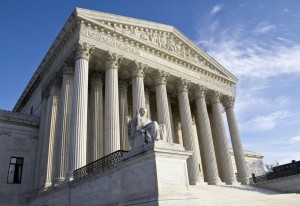 Legal news coverage was dominated this week by the Supreme Court Shuette decision, which upheld Michigan’s affirmative action ban for college admissions. Read a summary below of the Court’s decision along with a few other interesting opinions picked out by our writers this week.
 The Federal Election Campaign Act of 1971 and the Bipartisan Campaign Reform Act of 2002, impose base limits, restricting how much money a donor may contribute to a particular candidate or committee, and aggregate limits, restricting how much money a donor may contribute in total to all candidates or committees, 2 U.S.C. 441a. In the 2011–2012 election cycle, McCutcheon contributed to 16 federal candidates, complying with all base limits. He alleges that the aggregate limits prevented him from contributing to additional candidates and political committees and that he wishes to make similar contributions in the future. McCutcheon and the Republican National Committee challenged the aggregate limits under the First Amendment. The district court dismissed. The Supreme Court reversed, with five justices concluding that those limits are invalid. Regardless whether strict scrutiny or the “closely drawn” test applies, the analysis depends on the fit between stated governmental objectives and the means selected to achieve the objectives. The aggregate limits fail even under the “closely drawn” test. Contributing to a candidate is an exercise of the right to participate in the electoral process through political expression and political association. A restriction on how many candidates and committees an individual may support is not a “modest restraint.” To require a person to contribute at lower levels because he wants to support more candidates or causes penalizes that individual for “robustly exercis[ing]” his First Amendment rights. The proper focus is on an individual’s right to engage in political speech, not a collective conception of the public good. The aggregate limits do not further the permissible governmental interest in preventing quid pro quo corruption or its appearance. The justices noted the line between quid pro quo corruption and general influence and that the Court must “err on the side of protecting political speech.” Given regulations already in effect, fear that an individual might make massive unearmarked contributions to entities likely to support particular candidate is speculative. Experience suggests that most contributions are retained and spent by their recipients; the government provided no reason to believe that candidates or committees would dramatically shift their priorities if aggregate limits were lifted. Multiple alternatives could serve the interest in preventing circumvention without “unnecessary abridgment” of First Amendment rights, such as targeted restrictions on transfers among candidates and committees, tighter earmarking rules, and disclosure.
 Defendant-appellant Gwen Bergman was arrested when the hit-man she thought she hired to kill her husband was in fact an undercover police officer. After trial, it emerged that defendant’s lawyer was not a lawyer-in-fact, but a con man. Defendant applied for habeas relief on the ground that she received ineffective assistance of counsel. The district court agreed with her: the court vacated her conviction, and discharged her from supervised release (she had finished her prison term). Assuming the court’s decision to vacate the conviction it won at defendant’s first trial was without prejudice to a new trial with a (real) defense lawyer, the government asked the court to set a date. The district court refused, stating that its discharge order “implicitly” forbade any effort to secure a valid conviction at a second trial. The government appealed the district court’s decision to the Tenth Circuit. The government’s appeal raised the question of whether defendant could be exposed to a new trial and lawful conviction despite having successfully petitioned for habeas relief and served her jail sentence. Rather than contend categorically that only double jeopardy problems may preclude retrial, the government suggested that the remedy the district court selected was too attenuated from the right it found violated: defendant’s Sixth Amendment right to effective assistance of counsel. “[T]he presumptively appropriate remedy for a trial with an ineffective lawyer is a new trial with an effective one. . . . the district court failed to identify any reason why that presumption is inapplicable here; and in these circumstances refusing a new trial amounts to an abuse of discretion.”


