 On August 29, Multimedia Patent Trust (“MPT”) filed a patent infringement lawsuit against Apple in the U.S. District Court for the Southern District of California. The patent at issue is U.S. Patent No. 5,500,678, entitled “Optimized Scanning of Transform Coefficients in Video Coding.” In essence, the patent describes a method of digital video compression.
The complaint first alleges that several of Apple’s products, including the iPhone 4S, iPad 2, and the “new iPad” encode video in a way that infringes on MPT’s ‘678 patent. Second, MPT alleges that a handful of Apple software uses the patented methodology “by virtue of the manner in which they encode video.” The third allegation of infringement focuses on the Apple computers as a whole, naming the virtually all current and recent lines of the company’s computers, including the Mac Mini, Mac Pro, MacBook, MacBook Pro, and MacBook Air.
 Petitioner was found guilty of the murders of two brothers. The trial court sentenced Petitioner to death. The Supreme Court affirmed. Petitioner subsequently filed a habeas corpus petition for relief from the judgment of death. The Supreme Court ordered an evidentiary hearing on Petitioner’s claim that the prosecution had failed to disclose evidence that would have supported a case in mitigation at the penalty phase that Petitioner committed the two murders because of a Colombian drug cartel’s death threats against him and his family. The referee found merit to Petitioner’s claim. The Supreme Court upheld the determination by the referee and granted Petitioner’s habeas corpus petition, holding (1) substantial evidence supported the referee’s determination, and (2) it was reasonably probable that Petitioner’s penalty phase jury would have returned a verdict of life imprisonment without parole had it heard the evidence withheld by the prosecution.
 Blue Spike, LLC filed a
  Yesterday, a Northern California jury announced their verdict in one of the most highly anticipated decisions of the high technology era: Samsung must pay Apple $1.05 billion in damages for patent infringement.
 One of the threshold questions before a person or entity may sue another in federal court is one of judicial standing. When the person or entity is suing for prospective relief—that is, a court order preventing a harm that has not yet occurred, the threshold is particularly high. Under the Supreme Court case
  On Wednesday, New York City
 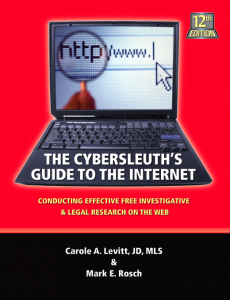 ABA authors and Cybersleuth seminar speakers Carole Levitt and Mark Rosch have revised and updated their book, The Cybersleuth’s Guide to the Internet, now in its twelfth edition.
 H-W Technology LC is suing Apple and 31 other companies for